Juneteenth
By black.wiki team · June 15, 2026 · 3 min read
January 1, 1863
The Emancipation Proclamation
President Abraham Lincoln issues the Emancipation Proclamation, declaring 'that all persons held as slaves' within the Confederate states 'are, and henceforward shall be free.' But the Proclamation is a wartime measure with no enforcement mechanism beyond the Union Army itself — freedom only becomes real where Union troops can reach. In states still under Confederate control, enslaved Black people remain in bondage. Texas, the westernmost slave state, has the fewest Union soldiers on its soil; for over two more years, the Proclamation's promise simply does not reach the ~250,000 enslaved people living there.
June 19, 1865
General Order No. 3 in Galveston
Major General Gordon Granger lands at Galveston, Texas with roughly 2,000 Union troops and posts General Order No. 3 across the city. It reads, in part: 'The people of Texas are informed that, in accordance with a proclamation from the Executive of the United States, all slaves are free. This involves an absolute equality of personal rights and rights of property between former masters and slaves.' It is the moment freedom becomes enforceable in Texas — two and a half years after the Emancipation Proclamation and more than two months after Robert E. Lee's surrender at Appomattox. June 19, 1865 is the date Black Americans would carry forward as Juneteenth.
Starting June 19, 1866
Jubilee Day and the first celebrations
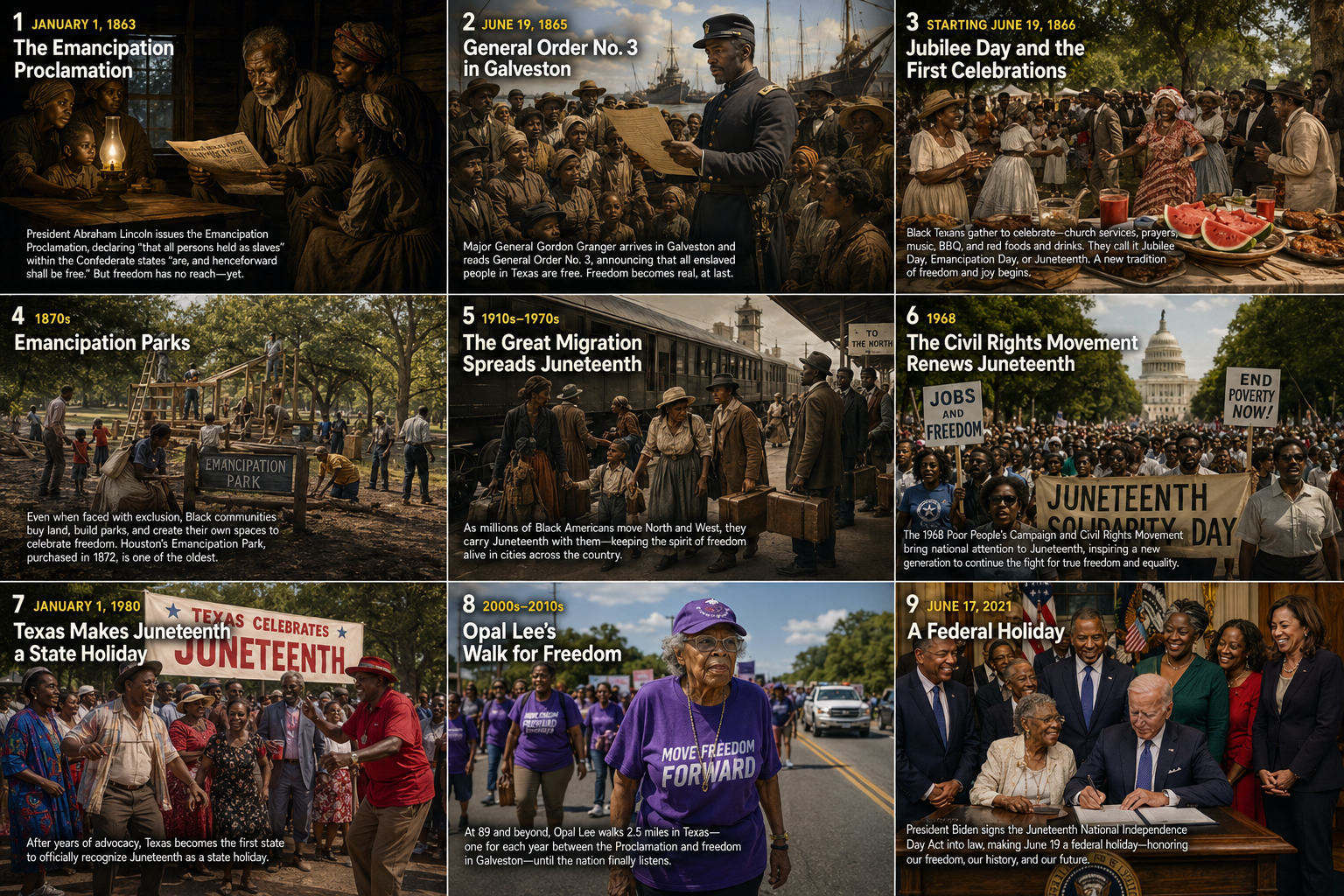
One year later, Black Texans gather to mark the anniversary of their freedom — calling it Jubilee Day, Emancipation Day, or, eventually, Juneteenth. The first observances center on church services, freedom prayers, Scripture readings of the Emancipation Proclamation, music, BBQ, and red foods and drinks (red soda, red velvet cake, watermelon) carrying both West African symbolism and a memorial to the blood of the enslaved. Even when white authorities push back — barring Black gatherings from public parks in some Texas cities — Black communities pool money to buy land for their own 'Emancipation Parks' so the celebrations can continue. Houston's Emancipation Park, bought in 1872, is one of the oldest.
1910s–1970s
The Great Migration spreads Juneteenth
As millions of Black Americans leave the South during the Great Migration, Black Texans carry Juneteenth with them to cities across the country. Observances spread to Los Angeles, Oakland, Milwaukee, Chicago, Detroit, and dozens more cities. The holiday loses some of its public visibility during Jim Crow and the early 20th century, but the Civil Rights movement of the 1960s — and especially the 1968 Poor People's Campaign, whose 'Juneteenth Solidarity Day' march on June 19 draws an estimated 50,000 to Washington — renews national attention. From the late 1960s on, more and more Black communities and organizations adopt Juneteenth as a yearly observance.
January 1, 1980
Texas makes Juneteenth a state holiday
After a years-long push by Texas State Representative Al Edwards of Houston, Juneteenth becomes an official Texas state holiday on January 1, 1980 — the first state in the country to grant it formal recognition. Over the following four decades, every other state except South Dakota follows with some form of recognition (holiday, observance, or proclamation). Throughout the 2000s and 2010s, activist Opal Lee — born in 1926 in Marshall, Texas — leads annual 'Walks for Freedom' covering 2.5 miles (one mile for each of the 2.5 years between the Proclamation and Galveston) to push for federal recognition.
June 17, 2021
A federal holiday
President Joe Biden signs the Juneteenth National Independence Day Act into law, making June 19 the eleventh federal holiday in the United States and the first new one created since Martin Luther King Jr. Day in 1983. Ms. Opal Lee — 94 years old at the signing — stands by his side. The law arrives 156 years after Granger read General Order No. 3 on a balcony in Galveston, and after decades of work by Black Texans, civil rights organizations, and Lee herself. Juneteenth is now observed nationally as a day to celebrate Black American freedom, culture, and resilience — while remembering that the official end of slavery and the lived reality of freedom were, and continue to be, two different things.